
From a sentence to a verdict you can forward.
Ryvetz turns a written flow into an executed test on a machine we operate, and hands back video, a trace of every action, and a judged verdict for every step you gave a criterion.
- 01 Describe
One flow, in plain English, with a criterion on the steps that matter.
- 02 Run
A hosted runner opens a supported application and drives it on a test account.
- 03 Judge
A separate model grades each criterion from the screenshot alone.
- 04 Read
Video, trace, and a cited verdict, in the dashboard or as a CI check.
It starts with a sentence
Write the test the way you would say it to a colleague. Every step is grounded on the live screen at run time, so nothing depends on selectors or coordinates.
Illustrative example
name: Invite a teammate and confirm the seat
app: acme-crm
account: staging

steps:
  - do: Open Settings › Members
  - do: Invite dana@example.com as an editor
  - do: Send the invite
    verify: The members list shows dana@example.com as Pending within 10 seconds
  - do: Revoke the invite
    verify: dana@example.com is no longer listed within 10 seconds
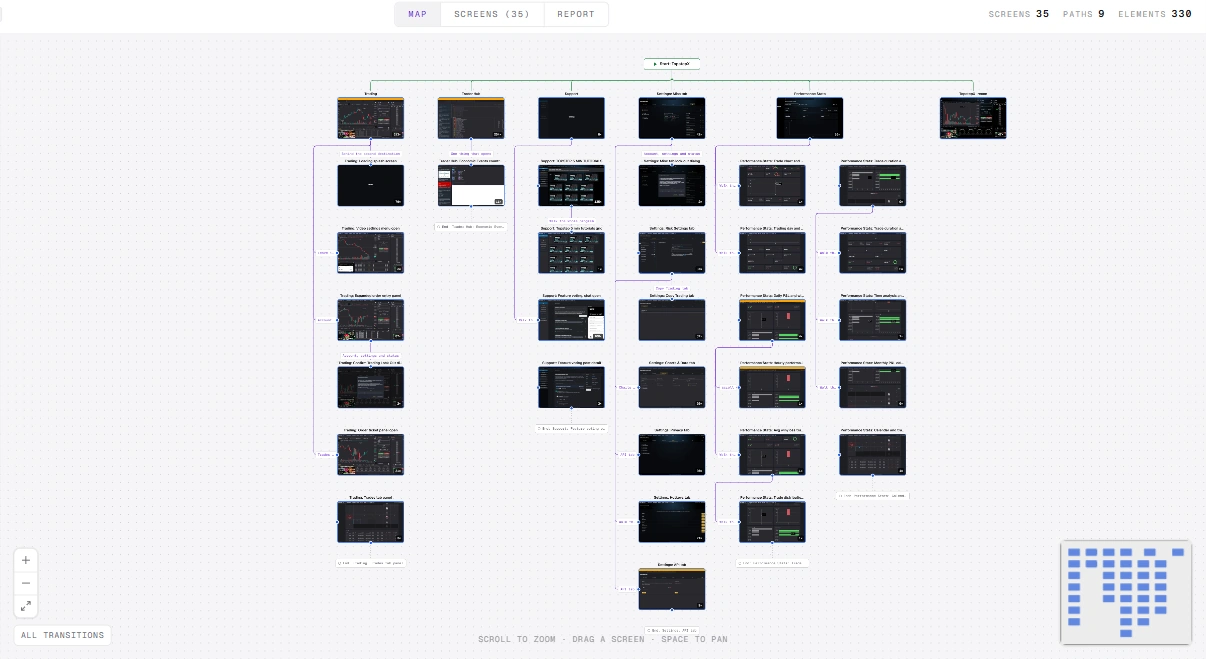
Plain-English steps
A step is what to do and, when it matters, what must be true afterwards. No page objects, no locators.
See it on a planGrounded on pixels
The executor looks at the real screen and finds the control the way a human would, so a moved button is not a broken test.
See it on a planRecovers from drift
When the interface changes, the agent sees the new screen and continues instead of failing on a missing selector.
See it on a planA verdict that cites pixels
The agent that clicks never grades itself. A separate strict judge sees only your criterion and the screenshot, and quotes what it used before anything passes.
Illustrative example
- The live screen
- The step to perform
- The Atlas of known controls
- Your verification criterion
- The screenshot. Nothing else.
“The avatar for dana@example.com failed to load: its URL reads ‘…acme-crm.example/avatarsundefined/’, missing the path separator.”
Split roles
Executor and judge are different models with different instructions. One acts, one decides.
See it on a planCriterion and screen only
The judge never sees the executor’s reasoning, so it cannot be talked into a pass.
See it on a planStrict by default
A pass the judge is not confident in is recorded as a fail, with the evidence attached.
See it on a plan“Yes, one broken element: the avatar for dana@example.com in Settings › Members failed to load. Its URL 'https://cdn.acme-crm.example/avatarsundefined/dana.png' is missing a path separator.”
Hosted machines we operate
Your laptop is not the test machine. Every supported platform ships as a curated image on a runner we run, with a session guard that refuses the wrong screens.
Illustrative example
- Image
- chrome-stable · acme-crm-profile
- Slot
- 1 run at a time, yours next
- Accounts
- Test and demo only
- Session guard
- Refuses log-out and real-money screens
- Tenancy
- Single-tenant, never shared
- Image
- Your golden image
- Accounts
- Real-money and live accounts
Nothing to install
You author flows in the browser or from the CLI. The runner, the browser, and the platform profile are ours to keep working.
See it on a planTest accounts only
Credentials are encrypted at rest, injected only for the length of a run, and never shown back in the UI.
See it on a planDedicated when it matters
Accounts with real money behind them, such as eval, funded, and live trading accounts, belong on a single-tenant runner under Enterprise. Never on a shared slot.
See it on a planEvidence your pipeline can gate on
Video, screenshots, and a typed trace for every run, plus JSON and exit codes. On Team, every pull request gets a check run.
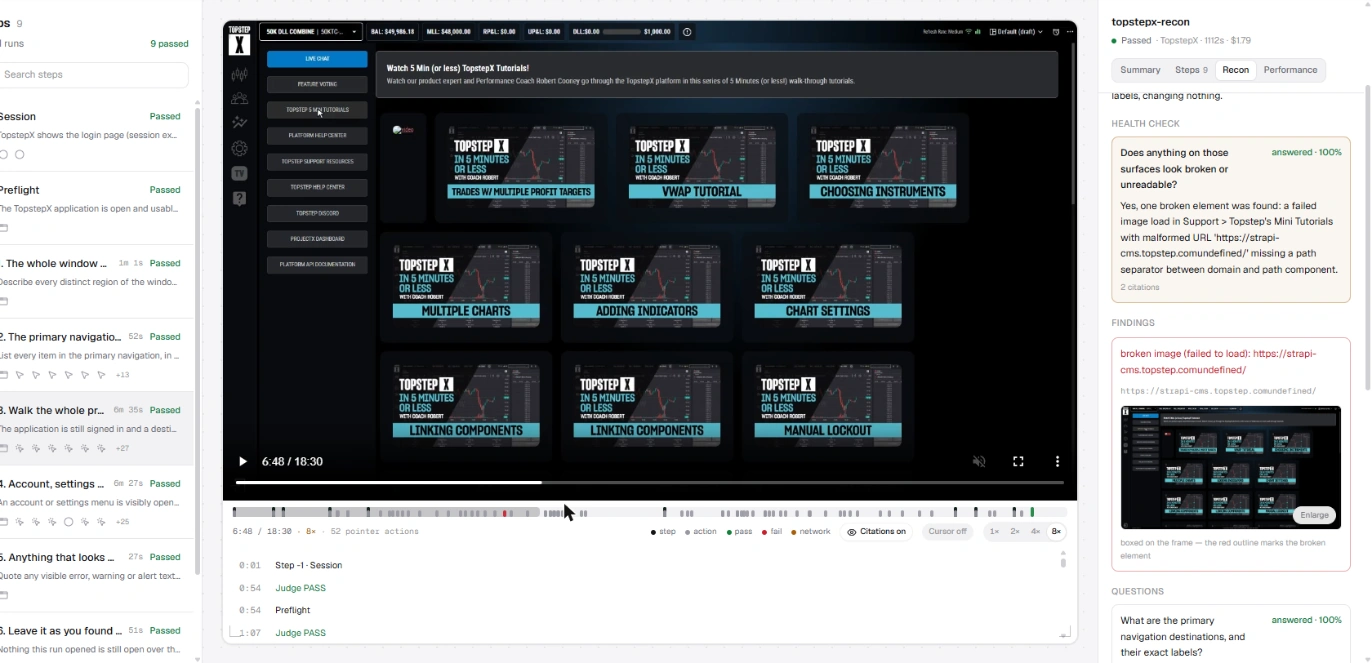
Video and trace
Every action is recorded and typed. Scrub to the step, read what the agent did, see what the judge cited.
See it on a planCI check runs
Install the GitHub App or call the webhook from your pipeline. Fail the release when the judge does.
See it on a planShare links
Time-limited capability URLs for a run, so a release manager can read the verdict without an account.
See it on a planShip with evidence.
Join the waitlist. Describe one flow, watch it run on a hosted machine, and read the verdict.